Depuis 2001, Shenheng Power est un fabricant de confiance d'équipements de transmission et de distribution d'énergie, fournissant des solutions électriques fiables à l'échelle mondiale.
Forts d'un système complet de service après-vente, nous fournissons des conseils techniques d'experts, des conseils sur les produits et des services OEM et ODM flexibles pour vos projets.
Depuis 2001, Shenheng Power est un fabricant de confiance d'équipements de transmission et de distribution d'énergie, fournissant des solutions électriques fiables à l'échelle mondiale.
A transformer polarization depolarization current test, usually called a PDC test, records the insulation current response during a controlled DC charging period and after the voltage is removed. The resulting curves help specialists investigate the dielectric behavior of an oil-paper insulation system. Interpretation depends on temperature, connection arrangement, measurement duration and the model used. A PDC report therefore needs more than a moisture percentage: it should show the measured response and explain how any estimated condition was derived. It cannot, by itself, certify remaining life or locate every insulation defect.
This guide explains how an owner can review a specialist’s report for an oil immersed transformer. It is not a connection diagram or a test instruction. Isolation, discharge, grounding and measurement require qualified personnel following an approved procedure and the equipment manufacturer’s requirements.
What the polarization and depolarization curves mean
During the charging interval, the measured current contains contributions from dielectric processes and conduction in the insulation system. After the applied voltage is removed under the specified arrangement, the recorded depolarization response reflects the relaxation of polarization. The two intervals belong to one controlled measurement sequence; treating them as unrelated spot readings loses useful context.
Le published comparative PDC study of high voltage insulation investigates conductivity and moisture assessment using this response. It supports the diagnostic principle, while its investigated specimens and assumptions should not be treated as universal acceptance limits for every transformer. Ask which part of the published method actually applies to the equipment under review.
A curve is influenced by the combined insulation system seen by the selected measurement connection. Oil and cellulose do not necessarily contribute in the same way at all times. A specialist may use different regions of the response to investigate different properties, but the interpretation needs its supporting model and measurement conditions.
Separate measured data from estimated condition
Current, elapsed time, voltage and recorded temperature are measurement information. An estimate of paper moisture or conductivity may be an interpretation produced by a model. Keep those categories visible in the final report. A software output with several decimal places is still an estimate when its inputs and assumptions have uncertainty.
Request the measured charging and discharging curves, the fitting or comparison method and any stated limitations. If only a final condition label is supplied, ask for the evidence that produced it. This allows an independent reviewer to distinguish a clear measurement from a confident-looking conclusion unsupported by the available record.
Report element
Pourquoi c'est important
Question de l'étude
Connection arrangement
Defines the insulation path being observed
Does it match the previous test?
Temperature record
Dielectric response changes with temperature
What temperature and correction were used?
Charging and discharging duration
Controls which response intervals were observed
Was the measurement long enough for the stated interpretation?
Raw curves and interference notes
Shows whether the response supports the conclusion
Were unstable or contaminated intervals excluded with reasons?
Model and confidence limits
Separates observation from estimation
How sensitive is the result to uncertain inputs?
This checklist describes report completeness. It does not supply test voltages, durations or pass and fail thresholds; those must come from the approved procedure for the actual equipment.
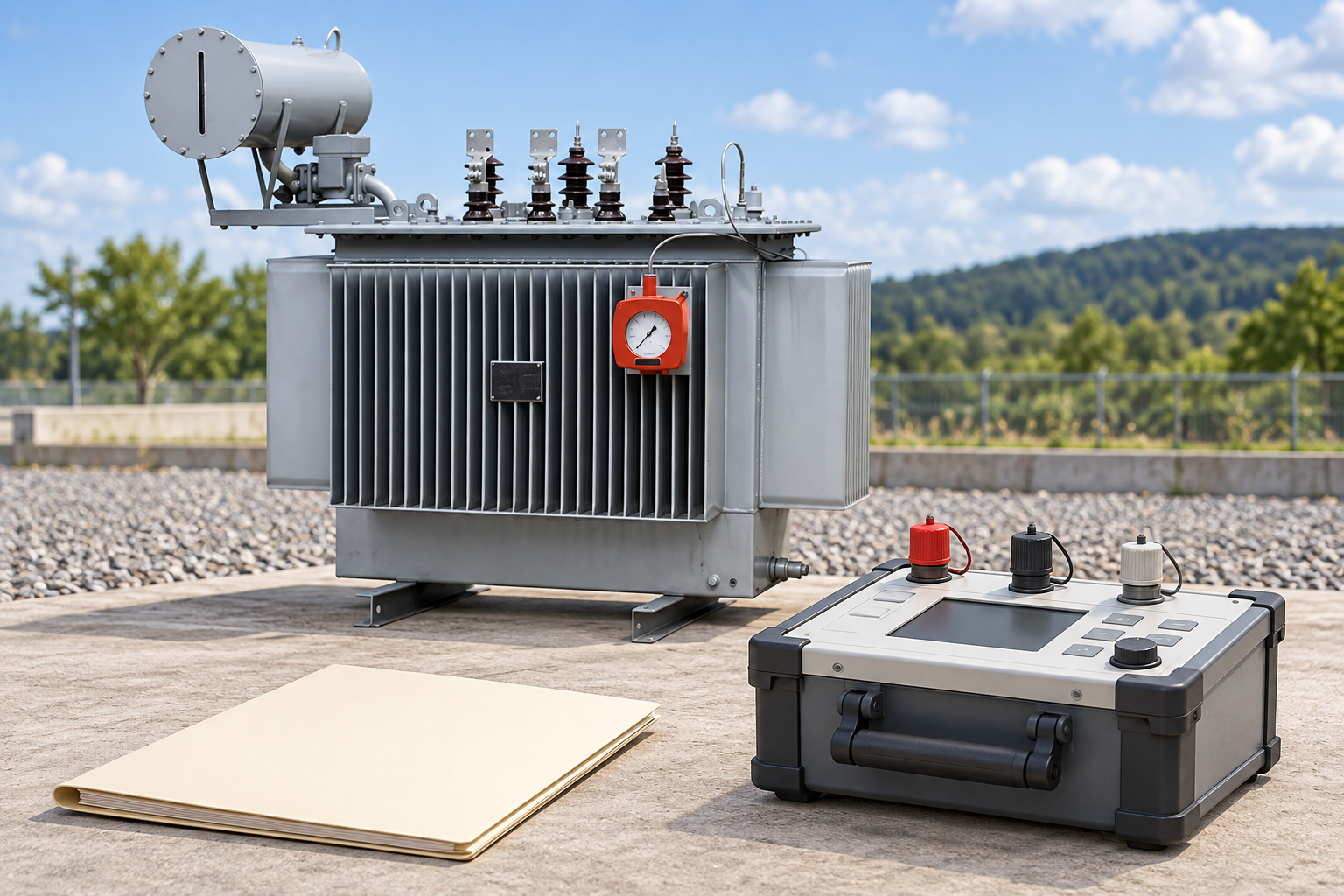
Conceptual illustration of documenting a dielectric response assessment; no live connection is shown.
Temperature deserves a clear explanation
Start with the temperature at the time of measurement and how it was obtained. Ambient air temperature, top oil indication and an assumed average insulation temperature are different quantities. If a correction was applied, identify its basis rather than accepting a generic statement that results were normalized.
A transformer recently removed from service may not be in thermal equilibrium. Ask the test specialist whether the recorded condition supports the interpretation and whether a temperature gradient could affect confidence. A plausible number in a report cannot replace the reasoning about what temperature the relevant insulation actually experienced.
For trending, retain both original and corrected data. Recording only the corrected curve makes it harder to revisit the assumptions later. If the correction method changes between visits, mark the change and ask whether the apparent trend remains meaningful under a consistent method.
Check connections and measurement quality before diagnosing damage
Identify the windings and terminals included in each measurement. Transformer construction, grounding and accessible terminals affect the observed insulation path. A result from a different connection cannot automatically be plotted as a direct continuation of an earlier series, even when both files carry the same transformer identification.
The report should describe significant interference, leakage concerns or unstable readings and explain how they were handled. Removing suspect data may be justified, but the excluded interval and reason should remain traceable. A clean fitted line is not evidence that the original measurement had no problems.
Ask whether the equipment was adequately discharged under the approved procedure before and after measurement. This is a record review question, not an instruction to touch or reconnect terminals. The test team remains responsible for safe execution, including the effects of stored charge and dielectric absorption.
Compare PDC with other insulation evidence
A transformer insulation resistance test is a different measurement with a different interpretation. A satisfactory resistance reading does not make a PDC assessment unnecessary when a specific dielectric response question remains open. Equally, a PDC curve should not be relabeled as a conventional resistance acceptance test.
Oil sampling can provide complementary evidence, but a liquid sample does not directly reveal every property of the solid insulation. Keep the sampling point and specimen history with the dielectric report when comparing findings. Changes in liquid condition and paper condition may require different explanations.
A sweep frequency response analysis investigates another diagnostic question associated with electrical response and mechanical condition. It should not be confused with low frequency dielectric response simply because both methods produce curves. The work order should name the actual question each test is intended to answer.
Review a surprising estimate in stages
First check asset identity, connection, units, temperature and the original curve files. Confirm that the reported value belongs to the correct winding arrangement and that the analyst used the intended equipment information. Administrative and configuration errors are worth excluding before planning an intrusive intervention.
Next ask the specialist to explain model sensitivity. Which assumptions about insulation geometry, oil conductivity or temperature drive the estimate? A report should distinguish a robust conclusion from one that changes substantially when uncertain inputs are varied within a plausible range.
Finally combine the result with operating history and other relevant tests. A confirmation measurement, additional laboratory evidence or continued monitoring may be appropriate, but the responsible engineer must choose the action. Do not turn a general internet example into a drying instruction for an individual transformer.
Preserve original measurements and interpretation assumptions together in the asset record.
Specify useful deliverables before ordering the test
Pour un oil immersed power transformer, agree the purpose of the assessment with the specialist before testing. A commissioning baseline, investigation after storage and review of an aging unit may require different comparisons. Product appearance cannot establish the condition of internal insulation.
Use the broader transformer procurement guide to identify documentation responsibilities. State who supplies construction information, who approves the measurement procedure and who interprets the result. This avoids receiving a technically detailed report that no party is responsible for turning into a decision.
Request editable numerical data where available, readable plots, connection identification, timestamps, temperature information, method description and the analyst’s limitations. Define how the report will be retained so that a later measurement can be compared without reconstructing the original setup from memory.
Keep oil maintenance and equipment diagnosis distinct
The public scope of IEC 60422:2024 concerns supervision and maintenance of mineral insulating oils. Its boundaries help prevent oil maintenance findings from being treated as a complete assessment of the transformer. A dielectric response interpretation should likewise state which insulation properties it addresses and which questions remain outside its scope.
Record the final decision in plain terms: what was measured, what was inferred, what uncertainty remains and what action was authorized. Keep any maintenance recommendation connected to its supporting evidence. A future reviewer should be able to understand the reasoning without relying on the original analyst’s memory.
For a fleet programme, consistent reporting is often more useful than collecting an ever larger number of disconnected measurements. Use a common record structure while allowing equipment-specific interpretation. Consistency means preserving context, not applying one numerical threshold to every design and service history.
A useful commissioning baseline should identify the transformer’s condition when the record was created. Note whether the equipment was newly filled, recently processed, stored for a period or returned from service. These descriptions do not diagnose condition, but they prevent later reviewers from treating unlike stages as equivalent. Keep the timing of any oil treatment or drying operation with the measurement sequence, and ask the specialist whether an immediate comparison is appropriate. If the report cannot support a numerical condition estimate, a qualified description of the measured response is preferable to an unsupported percentage.
Formation continue
The NPTEL lecture on dielectric insulating solids provides background on polarization in insulation. It is not a transformer PDC operating procedure or a condition certificate for this product.
Shenheng Electric Power s'engage à devenir un leader mondial des solutions d'équipements électriques, aidant les clients à réaliser une gestion de l'énergie sûre, efficace et durable.

 Shenheng Power Equipment Co., Ltd.