Kể từ năm 2001, Shenheng Power đã là nhà sản xuất thiết bị truyền tải và phân phối điện đáng tin cậy, cung cấp các giải pháp điện năng đáng tin cậy trên toàn cầu.
Được hỗ trợ bởi hệ thống hậu mãi toàn diện, chúng tôi cung cấp dịch vụ tư vấn kỹ thuật chuyên gia, hướng dẫn sản phẩm và các dịch vụ OEM & ODM linh hoạt cho các dự án của bạn.
Kể từ năm 2001, Shenheng Power đã là nhà sản xuất thiết bị truyền tải và phân phối điện đáng tin cậy, cung cấp các giải pháp điện năng đáng tin cậy trên toàn cầu.
Ultrasonic inspection of switchgear listens for high-frequency acoustic activity that may indicate discharge or other abnormal processes. It is useful as a screening and trending tool, particularly where trained inspectors can survey approved accessible points without opening energized compartments. A detected signal is a reason to investigate; it is not automatically a quantified partial-discharge result. Equally, a quiet reading cannot prove that every compartment is free of insulation defects.
This guide explains how to specify a repeatable survey, distinguish useful evidence from background noise and connect findings to a maintenance decision. Access, approach distance and any energized work must follow the site’s electrical safety rules and the equipment instructions.
What an ultrasonic survey actually measures
Electrical discharge can create acoustic emissions. An ultrasonic instrument detects selected high-frequency sound and may translate it into a range the operator can hear, display a relative level or record a waveform. The observed signal depends on the sensor, instrument settings, sound path, distance, background and equipment enclosure.
Airborne ultrasound and structure-borne measurements use different coupling paths. The actual inspection method must match the equipment and sensor. A reading near an accessible enclosure opening and a reading obtained through a contact sensor are not necessarily comparable measurements of the same source.
Start with the broader partial discharge in switchgear guide to understand the condition being investigated. Ultrasound contributes evidence to that investigation, but it does not reveal every defect or determine a universal remaining service life.
Acoustic screening is different from apparent-charge measurement
Các IEC 60270:2025 scope concerns charge-based partial-discharge measurement and its measurement arrangements. An ultrasonic amplitude or instrument dB reading should not be relabelled as a calibrated apparent-charge result in picocoulombs. These measurements use different physical paths and calibration concepts.
A field survey may be useful without producing a laboratory acceptance value. Its purpose can be to locate a repeatable anomaly, compare accessible positions over time and select the next investigation. State that purpose in the inspection plan so the report does not promise more than the technique can establish.
Other methods may observe electrical, electromagnetic or acoustic effects through different sensors. The partial discharge detection methods guide explains why a complementary method can add information. Agreement between appropriate methods is stronger evidence than repeating one poorly controlled measurement many times.
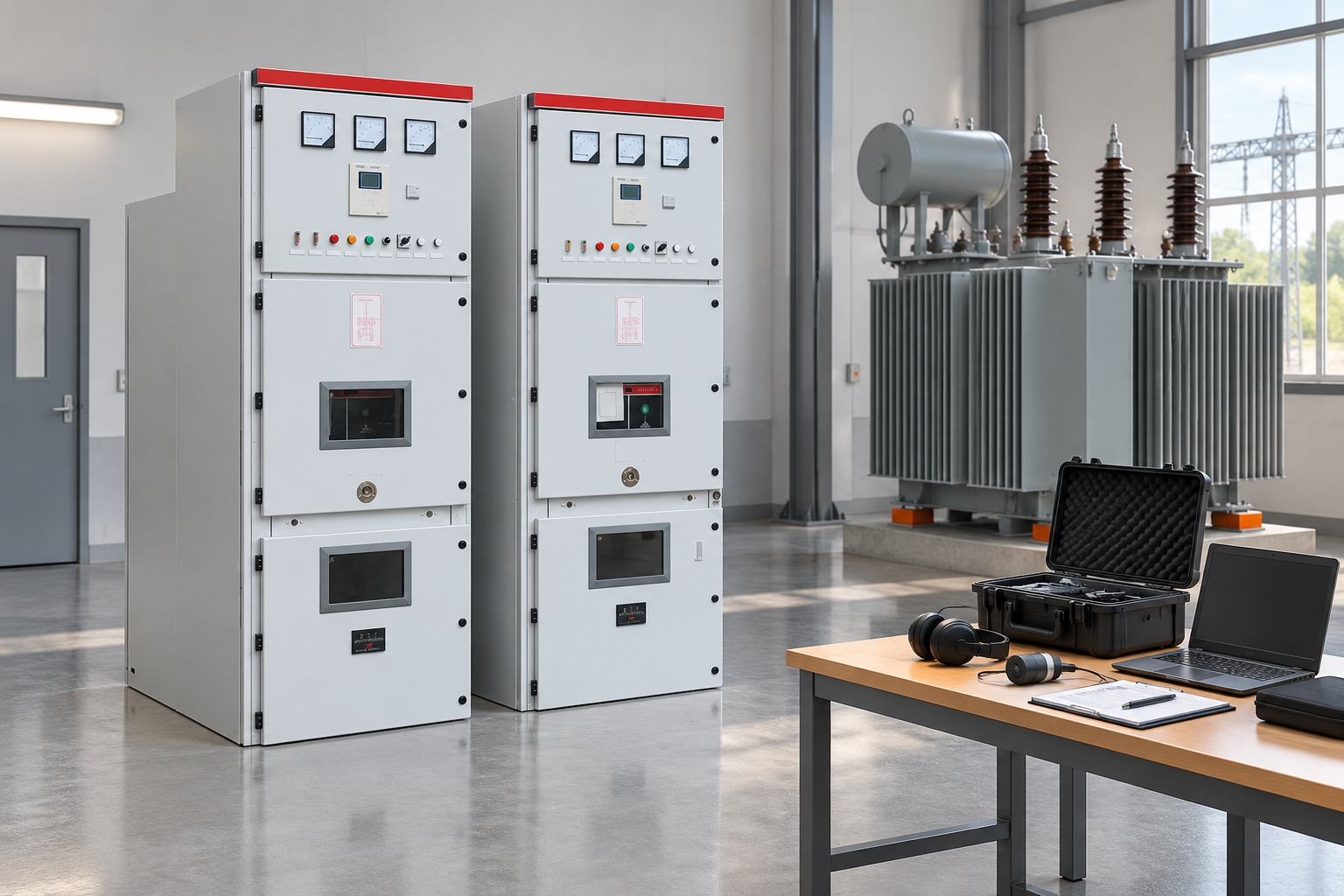
Preserve position, instrument settings and background information. Reference-based illustration.
Build a survey route that can be repeated
Identify the switchboard, panel numbers, compartments and approved accessible observation points. The route should show where the inspector stands or places an authorized sensor, not merely the cabinet number. Preserve the route drawing and photographs that identify the point without requiring a future inspector to guess its position.
Record the instrument, sensor, settings, measurement method and relevant calibration or verification status. Include distance and orientation where they influence the result. If an instrument or sensor changes, document that change rather than assuming the new reading belongs on the old trend without qualification.
Site conditions also matter. Note equipment state, load information when available, weather or humidity conditions relevant to the installation, and nearby acoustic sources. Cooling fans, compressed-air leaks and other mechanical activity can interfere with the observation. The survey should establish a background reference through approved safe positions.
Consistency makes the trend useful. Where a panel’s accessible geometry changes after maintenance, create a new documented reference rather than forcing the new observation onto a historical point that no longer exists.
Keep the survey within the authorized safety boundary
Listening from outside a closed enclosure does not remove the electrical hazard of the location. A non-contact sensor is not permission to approach closer, defeat an interlock or open a door. The approved work method must establish accessible points and how the inspector handles a suspected abnormal condition.
Các US electrical power safety provisions provide a reference where they apply. Local rules, owner requirements and equipment instructions govern the actual job. A survey report should describe inaccessible positions honestly instead of marking them as inspected.
If an unexpected audible discharge, smell, visible damage or protection event occurs, the inspector should follow the site’s escalation procedure. Do not continue experimenting with sensor positions to obtain a more impressive signal. The operating authority should decide how to secure the situation and what investigation is appropriate.
Interpret patterns before comparing levels
An instrument may show a relative level that is convenient to trend. That does not make the number universal across brands, settings or sensor types. A different bandwidth, gain, reference convention or acoustic path can change the displayed value even if the underlying source is unchanged.
Compare like with like. Use the same documented point, method and settings, with enough context to explain differences. Keep the raw recording or instrument export when available. A written description such as “noisy panel” does not allow a second reviewer to assess what the instrument actually detected.
Acoustic character can help a trained specialist formulate a hypothesis, but it should not become an automatic fault label. Different sources can resemble each other, and the enclosure can filter or obscure the original emission. Report the observation separately from the suspected mechanism.
A practical finding-to-action table
This table is a qualitative review aid. It deliberately avoids universal dB alarm limits, because those require the actual instrument, method and asset procedure.
Survey observation
Check before interpretation
Useful supporting evidence
Report outcome
Repeatable signal concentrated at one accessible point
Stable settings, position and background
Recording, route photograph and panel identity
Flag a localized anomaly for qualified review
Similar sound across many panels
Shared environmental or mechanical source
Background comparison and equipment operating state
Explain whether the pattern is equipment-specific
Signal changes after moving the sensor
Distance, direction and acoustic path
Position record and approved repeat measurements
Define the reproducible point rather than the loudest value
Quiet result through a solid enclosure
Whether the sound path can reveal the target source
Compartment design and method limitations
Record limited coverage, not proof of no defect
Rise from an earlier survey
Method and conditions comparable
Historical recording, settings and operating notes
Confirm a trend or qualify the comparison
Conflicting ultrasonic and electrical findings
Different methods may observe different sources
Specialist review of both datasets
Plan a targeted follow-up, without averaging unlike units
Why a negative survey has limits
A sealed compartment, shielding, attenuation or an unfavorable sound path can prevent a source from producing a detectable external signal. A defect may also be intermittent or inactive under the conditions of the visit. These limitations belong in the report, especially when a customer asks whether the survey proves the equipment is healthy.
Coverage should be explicit. Distinguish surveyed and accessible points, inaccessible compartments and positions excluded by safety restrictions. A checklist with every panel marked green but no coverage explanation can conceal the very uncertainty the owner needs to manage.
Where the risk assessment requires stronger evidence, arrange an appropriate additional method or an outage-based examination. The choice should follow the suspected mechanism and actual design. An insulation resistance test can address a different aspect of insulation, but it is not a substitute for every partial-discharge investigation.
A quiet acoustic survey is not proof that every compartment is defect-free. Reference-based illustration.
Turn the recording into a maintenance decision
The reviewer should receive the raw observations, route, method, background information and relevant asset history. The assessment should identify plausible sources, confidence and the next action. That action could include specialist analysis, complementary measurement or an approved outage inspection, depending on the evidence and consequence of failure.
Assign an owner and completion date to the follow-up. If monitoring continues, state the reproducible measurement point and conditions that require escalation. “Check again later” is not a complete action when the asset is important and the anomaly is unexplained.
Các NETA maintenance testing standards page describes a broader maintenance framework. Use the applicable specification and equipment guidance to determine the actual program; an ultrasonic survey does not by itself demonstrate that every required maintenance test has been completed.
Specify accessible monitoring when buying switchgear
Ask the supplier which compartment arrangements and approved inspection interfaces are available. Clarify the equipment’s actual insulation technology, accessible points, operator restrictions and monitoring options. The KYN28 medium-voltage switchgear page provides product context, but the offered configuration and documentation must establish its construction; the product name alone is not a diagnostic method specification.
In the tender, distinguish a portable survey route from permanently installed monitoring. State what data should be exported, how panel identities are maintained and who interprets alarms. If the installation changes the access or enclosure layout, update the route after commissioning.
An acceptance discussion should include the handover baseline and any uninspected areas. Store that baseline with the final panel arrangement and inspection method. Future comparison then becomes an engineering exercise supported by records, rather than a comparison between two unexplained sound levels. Request an example report before appointing the inspection contractor so the owner can confirm that coverage, method limitations and actionable recommendations will be visible. The report should remain useful even when a different person performs the next survey.
Learn the partial-discharge principle
The educational video below explains the insulation phenomenon behind the inspection. Its purpose is conceptual learning; the field measurement method and operating decision remain specific to the equipment and authorized survey procedure.
Further learning: ECE Lecture by Dr. Chanyeop Park – Mississippi State University — ECE at MSU. This educational video supports the topic; it is not a product demonstration or an operating authorization. Mở video trên YouTube.
Các câu hỏi thường gặp
Does a quiet ultrasonic reading prove that switchgear has no partial discharge?
No. Acoustic access, attenuation, background and operating conditions limit what can be detected. Record coverage and limitations, and use appropriate complementary evidence when the asset assessment requires it.
Can ultrasonic dB values be converted directly to picocoulombs?
No general direct conversion applies. A relative acoustic level and a calibrated apparent-charge measurement describe different measurement paths and quantities. Do not label one as the other.
Should energized cabinet doors be opened to improve the signal?
An ultrasonic survey does not authorize opening energized compartments. Access must follow the equipment instructions, site safety procedure and the operating authority’s approval.
What should be saved for the next survey?
Save the panel identity, route point, instrument and sensor, settings, distance or coupling method, operating context, raw recording and interpretation. These details establish whether a later measurement is genuinely comparable.
Shenheng Electric Power cam kết trở thành công ty dẫn đầu toàn cầu về các giải pháp thiết bị điện, giúp khách hàng đạt được quản lý điện năng an toàn, hiệu quả và bền vững.

 Công ty TNHH Thiết bị Điện Thâm Hằng.