
 Shenheng Elektrik Ekipmanları Ticaret Limited Şirketi.



transformer voltage regulation formula is a focused engineering question that needs a defined boundary before a calculation, inspection or commissioning decision is made. Transformer voltage regulation describes the change in secondary-terminal voltage between a specified no-load condition and a specified load condition, usually with the primary voltage held constant. A common expression is voltage regulation = (no-load secondary voltage − full-load secondary voltage) ÷ full-load secondary voltage × 100%. The sign and reference convention must be stated because transformer studies also use approximate impedance formulas and phasor-based definitions. Use the actual transformer rating, power factor, tap position and test method when making a design decision.
The formula and reference state
If a transformer measures 415 V at no load and 400 V at the stated load, the regulation using full-load voltage as the denominator is (415−400)÷400×100 = 3.75%. The result is a voltage change, not an efficiency figure and not a guaranteed field value at every load. State whether the numerator uses no-load or rated-load voltage and whether the primary voltage is held constant.
Some data sheets use a percentage impedance approximation or a regulation value at a stated power factor. Those values are not interchangeable without checking the definition. Record frequency, tap position, winding connection and temperature correction. A calculation that omits the power factor can be misleading because reactive voltage drop changes with the load angle.
Resistance and reactance effects
The approximate voltage drop depends on the transformer per-unit resistance, reactance and load power factor. At lagging power factor, the reactive component usually adds to the drop. At leading power factor, it can reduce the drop and in some cases produce a negative regulation under the chosen convention. Use a phasor or per-unit method when the project requires more than a rough estimate.
Do not treat nameplate impedance as the same thing as voltage regulation. Impedance is measured under a specified test and includes magnitude information; regulation also depends on the resistive and reactive components and the load angle. Request the manufacturer’s loss or resistance data when a precise calculation is needed.
A worked three-phase example
Assume a transformer has a stated secondary no-load voltage of 415 V and a measured loaded terminal voltage of 400 V at the design current and power factor. Regulation is 3.75% using the full-load denominator. If the owner instead uses no-load voltage as the denominator, the displayed percentage changes. Both conventions can be calculated, but the report must name the denominator.
For a real project, repeat the measurement at the transformer terminals and at the receiving bus if cable drop matters. Cable impedance, parallel runs, starting current, harmonics and unbalanced phase loading can create a different customer voltage. Keep transformer regulation and downstream voltage drop as separate rows in the study.
Tap changers and operating voltage
Tap settings change the turns ratio so the transformer can maintain a useful secondary voltage over a defined primary range. A de-energized tap changer requires isolation before operation. An on-load tap changer has its own controls, limits, interlocks and maintenance requirements. Never move a tap based only on a formula without checking the nameplate and manufacturer instructions.
The tap position used in a test must be recorded with the primary voltage, secondary voltage, load current, power factor and temperature. A tap can correct a normal supply condition but cannot compensate for an undersized cable or a fault. Protection and insulation coordination must remain valid at every permitted tap.
Temperature and test conditions
Copper and winding resistance vary with temperature. Transformer voltage regulation measured cold may not match the value at operating temperature. Test equipment accuracy, lead placement, excitation, frequency and stabilization also influence the result. Use the applicable transformer standard and project test plan rather than comparing uncorrected figures.
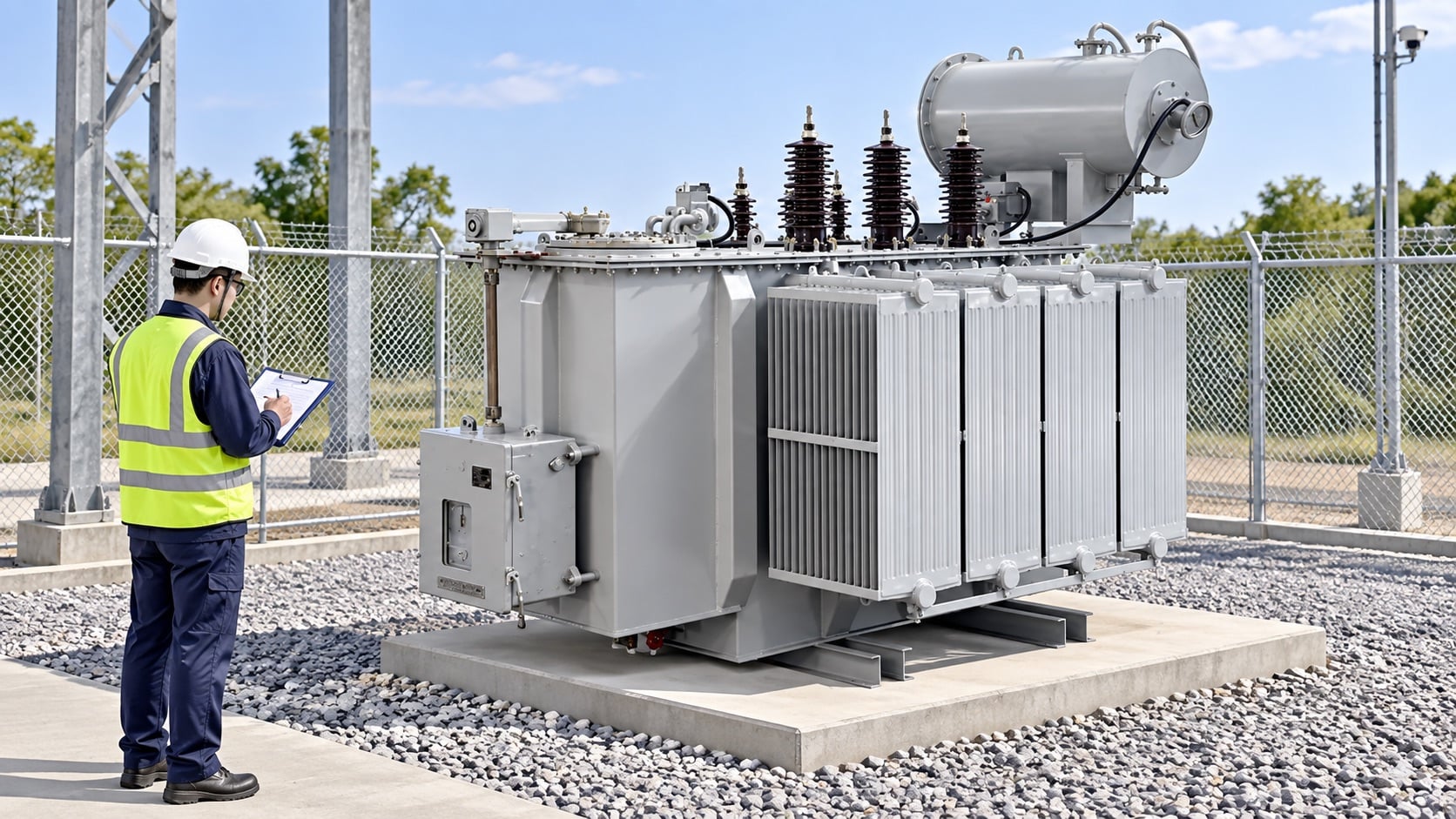
The dry or oil-immersed construction affects cooling and measurement practice, but the calculation still needs a defined state. For an oil-immersed industrial transformer, inspect the tank, bushings, tap mechanism and cooling equipment as part of commissioning. The product page linked here is an equipment reference, not a substitute for the supplied test report.
Load power factor
A lagging motor load generally produces a different voltage drop from a unity-power-factor resistive load at the same kVA. A leading correction-capacitor condition can change both magnitude and direction. Include the design power factor and any switched capacitor steps in the study.
If the load changes quickly, a static percentage may not capture starting or transient behavior. Review the motor-start study, harmonic assessment and protection settings where applicable. Report the operating point instead of presenting regulation as one immutable property of the transformer.
Field verification
Measure primary and secondary voltage with safe, calibrated equipment at no load and at representative load only under an approved procedure. Identify the exact terminals, tap, current, power factor, ambient and temperature. Keep people away from exposed energized parts and use the site electrical-safety program.
Compare the result with the manufacturer report using matching definitions. If the field value differs, check tap, supply voltage, load profile, cable drop, instrument ratio and connections before concluding that the transformer is defective. A single field number without context is not a diagnosis.
Procurement and reporting checklist
Request rated voltages, tap range, vector group, impedance, losses, regulation definition, test conditions, tolerance, cooling mode and terminal arrangement. State the load power factor and receiving-bus voltage requirement in the RFQ. Ask the supplier to show the calculation basis, not only a headline percentage.
Keep the turns-ratio test guide separate from regulation. A ratio test checks the winding relationship, while regulation describes voltage change under loading. The transformer sizing guide covers the rating decision around the formula.
| Kontrol edin | Kayda geçecek kanıt | Neden önemli |
|---|---|---|
| Tanım | Formula, boundary and operating state | Prevents two teams comparing different quantities. |
| Equipment | Rated voltage, current, construction and approved drawing | Links the calculation or checklist to the actual product. |
| Conditions | Ambient, temperature, power factor or pollution as applicable | Explains why field behavior can differ from a catalog value. |
| Onaylama | Test method, instrument, result and acceptance basis | Creates an auditable commissioning record. |
| Denetim kontrolü | Deviation, owner approval and as-built revision | Stops an unreviewed site change becoming a hidden risk. |
İlgili ürün ve mühendislik kılavuzları
Shenheng ürün bağlamı için bkz. ilgili ürün sayfası. Genel konuya ilişkin daha detaylı bilgi için okuyun Ana mühendis kılavuzu. İlgili okuma: ilk ilgili rehber ve İkinci ilgili rehber.
Kaynaklar ve standartlar
Yetkili kaynak 1 · Yetkili kaynak 2

Bir projede sonucu nasıl kullanabiliriz?
Start with the final equipment identity and the released design. Note the operating state, measurement point, environmental conditions and the decision the result must support. Then compare the evidence with the applicable standard, manufacturer instruction and project acceptance plan. If any prerequisite is missing, keep the item open rather than filling the gap with a generic value. This approach helps a buyer, commissioning engineer and operations team discuss the same physical asset.
For a supplier inquiry, ask for the calculation basis, verified arrangement, limits, test records and deviations. For site work, record the person, instrument, date, isolation boundary and restoration check. A concise but complete record is more useful than a long report that hides the one fact needed to approve the next step.
Safety and change control
Electrical equipment can retain energy or become energized from more than one source. Work that exposes conductors, removes barriers or changes a protection or control function requires an approved permit, isolation, absence-of-voltage verification and qualified supervision. Do not use this article as a switching instruction. If the installed arrangement differs from the drawing, stop and obtain engineering disposition before continuing.
After a test or inspection, restore covers, bonds, shutters, interlocks, labels and settings. Use an independent check for critical restoration steps. Record exceptions and link them to the final asset record. This protects future maintenance teams from relying on a temporary test state.
When evidence is incomplete, identify the missing input and assign a review owner. Do not backfill a rating, setpoint, clearance or test result from a different product family. Keep the product family, voltage class and site environment consistent from the first calculation to final handover. This makes later trend comparisons meaningful and gives procurement a clear list of questions for the supplier.
Sistem bağlamı için video
This neutral Practical Engineering explainer gives useful context for substations, transformers and switchgear. It is background education, not a project test instruction.

Sık sorulan sorular
What is the main mistake to avoid?
Treating one percentage, dimension or indicator as a universal acceptance value. The transformer voltage regulation formula decision must use the applicable standard, actual equipment and documented conditions.
Can the product page replace project engineering?
No. The linked product page identifies a relevant Shenheng product category. Ratings, accessories, settings and acceptance values must come from the project documents and supplied equipment.
What should be kept for handover?
Retain the approved drawing, raw readings, test method, instrument information, deviations, final settings and the as-built record so the result can be reproduced.
Does this guide authorize live work?
Hayır. Yetkili personel, site elektrik güvenliği programını, izolasyon ve üretici talimatlarını takip etmelidir.




