Desde 2001, a Shenheng Power tem sido um fabricante de confiança de equipamento de transmissão e distribuição de energia, fornecendo soluções elétricas fiáveis a nível global.
Apoiados por um sistema pós-venda completo, fornecemos consultoria técnica especializada, orientação de produtos e serviços flexíveis de OEM e ODM para os seus projetos.
Desde 2001, a Shenheng Power tem sido um fabricante de confiança de equipamento de transmissão e distribuição de energia, fornecendo soluções elétricas fiáveis a nível global.
IEC 61439 Guide for Low Voltage Switchgear Assemblies
Release Time: 2026-10-13
IEC 61439 low voltage switchgear procurement requires a buyer to define the applicable assembly standard, operating conditions and verification evidence for the complete supplied assembly. Specifying individually compliant breakers or a familiar cabinet name does not establish compliance of the assembled switchboard. The practical task is to connect the project requirements to an identified design, the manufacturer’s responsibilities, its verification records and the checks on the finished equipment. This guide focuses on that evidence trail for industrial low voltage power switchgear and controlgear assemblies; it does not certify a product from its photograph or replace the complete standard.
Identify the assembly before choosing the standard
Begin with what the assembly will do. An industrial power distribution switchboard, a board intended for operation by ordinary persons and a specialist assembly may need different parts of the IEC 61439 series. Record the incoming supply, intended users, circuit duties and installation location before writing a compliance sentence into the enquiry.
The official IEC 61439-2:2020 publication record identifies Part 2 for power switchgear and controlgear assemblies and its use alongside the general requirements. Its public scope includes rated voltages up to 1,000 V AC or 1,500 V DC. These are scope boundaries, not recommended project ratings. Select the applicable part and edition with the project engineer, considering local adoption and contractual requirements.
Avoid a medium voltage terminology shortcut. IEC 61439 is a low voltage assembly series; the separate medium voltage equipment standards and classification questions should be reviewed under their own applicable scope. Our medium voltage switchgear guide provides the broader equipment context, while the present article concerns low voltage assembly verification and procurement.
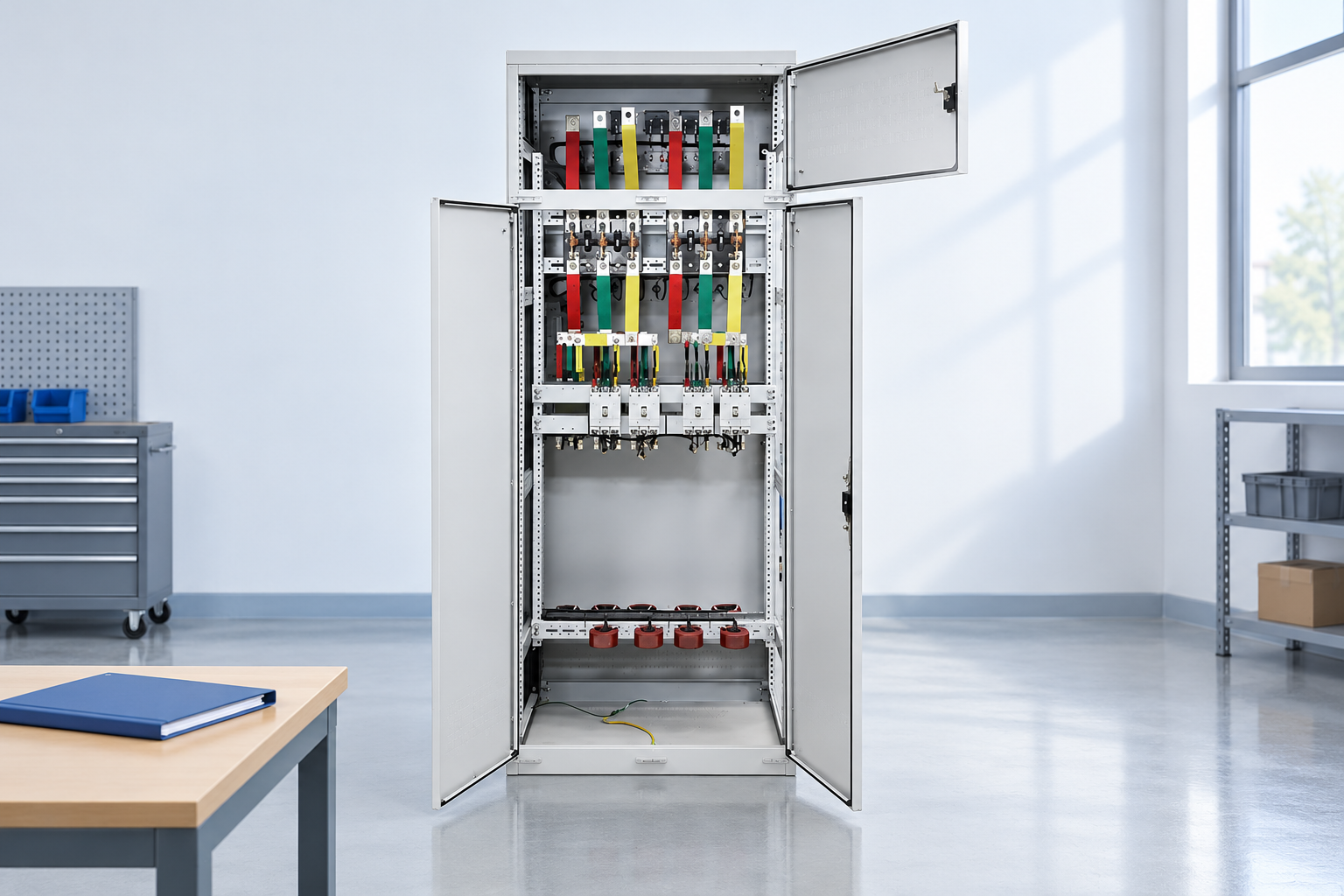
Match the supplied configuration to its verification evidence. Reference-based illustration.
Write an enquiry that can be verified
An enquiry needs a stable set of inputs. Include nominal and rated circuit information, frequency, system earthing arrangement, fault study inputs, load schedule, operating sequence and the intended installation environment. Document the origin and revision of each input so the manufacturer knows which issue controls its proposal.
Distinguish available fault current from equipment capability. A short circuit study describes the supply system at a location; the proposal must then identify the relevant assembly and protective device performance against that duty. Do not substitute a breaker marking for the assembly evidence or compare unlike ratings without reviewing their definitions and conditions.
Environmental assumptions matter. State indoor or outdoor use, ambient conditions, altitude, enclosure requirements, ventilation provisions, contamination and access constraints. If the enclosure or installation changes after approval, ask the manufacturer to review the effect rather than assuming the original evidence still applies. A large room and an enclosed container can impose different cooling conditions on equipment with the same circuit schedule.
Describe maintainability as an actual task. List the equipment that may need replacement, expected isolation boundaries, cable access and permissible downtime. This is more useful than asking for an unexplained “highest form” or an oversized cabinet. The separate low voltage enclosure IP guide examines the environmental protection question, which must also be coordinated with the access plan.
Separate design verification from checks on each finished assembly
Design verification concerns whether the assembly design meets the applicable requirements. Routine verification concerns the individual assembly delivered. A buyer should request a clear document schedule for both rather than accepting an undifferentiated promise that the equipment was tested.
O BEAMA technical guidance index provides industry guidance on verification and assembly ratings. Review the relevant document and the applicable standard with qualified personnel when deciding which verification method and evidence are acceptable. Not every property uses the same method, and no generic checklist can establish acceptance of an unidentified design.
Ask who owns the original design and who manufactures the ordered assembly. When an assembly manufacturer changes devices, conductor arrangements, enclosure details or cooling provisions, it must establish the validity of the resulting design. A substitution that looks equivalent to a purchasing department may change the assumptions underpinning verification.
For each submission, retain equipment identity and traceability. The project should be able to determine which assembly arrangement the records describe, what conditions apply and whether the ordered variant remains within those conditions. Missing or inconsistent identifiers deserve clarification before the factory build advances.
A useful evidence schedule for quotation review
The following qualitative schedule organizes a buyer’s review. It does not reproduce mandatory test limits or prescribe a universal acceptance method. Use the applicable standard and approved manufacturer documents to establish the exact checks and responsibilities.
Project question
Evidence to request
Review action
What assembly is offered?
Identified layout, circuit schedule and rating schedule
Match them to the enquiry revision
Which standard applies?
Part, edition and declared scope
Confirm local and contractual applicability
How is the design verified?
Traceable verification schedule and applicable records
Review conditions and permitted variants
How is the delivered unit checked?
Routine verification procedure and completed records
Confirm equipment identity and completeness
What changed after approval?
Controlled substitution or deviation record
Obtain documented design review
Can the room support operation?
Installation instructions and heat removal information
Coordinate building services and access
How will maintenance work?
Isolation, access and replacement arrangements
Compare against actual maintenance tasks
Use this schedule to identify gaps between proposals rather than awarding points for document volume. Ten unrelated certificates can provide less useful evidence than one complete, traceable verification record for the actual configuration. Keep every unresolved exception visible in the commercial comparison so price does not conceal a different scope.
Component selection belongs to the complete assembly
Breakers, contactors, busbars, supports and enclosures function together. Their individual ratings do not resolve all the interactions within the assembly. Device arrangements, thermal conditions, connections and protection coordination need the assembly manufacturer’s review under the applicable verification basis.
Define substitution control in the purchase order. Require proposed changes to identify the affected drawings and evidence, the reason for substitution and the review outcome. A device shortage late in production should trigger a controlled engineering decision, not an unrecorded change followed by an unchanged compliance declaration.
The same discipline applies to site modifications. Adding a feeder, changing cable termination space or altering ventilation can affect the assembly configuration. Establish who reviews those changes and what information is required. Keep the accepted drawings with the maintenance records so future work begins from an accurate configuration.
Installation conditions must match the proposal
Coordinate cable entry, connection space, access, floor support, transport dimensions and room ventilation while drawings can still change. These are project interfaces rather than minor details left for the installer. Resolve conflicts before production wherever possible.
Plan isolation and access around the actual circuit arrangement. An open door or an isolated outgoing circuit does not establish that all adjacent parts are deenergized. Qualified personnel must use the approved procedures, local electrical safety requirements and manufacturer instructions. Internal separation is a design feature; it does not grant permission for live maintenance.
Our low voltage switchgear product page provides the real equipment reference for the illustrations. The images show a product category and general review scenes. They do not establish a certification, a verified configuration or a particular form of separation. Request project specific documents for the proposed assembly.
Coordinate ventilation and access with the approved design. Reference-based illustration.
Factory acceptance and receiving inspection
Agree the factory review scope before ordering. Identify document review, inspections, witnessed activities if required, reporting format and the treatment of deviations. Our switchgear factory acceptance checklist covers the coordination of that review; the exact required procedures still depend on the ordered equipment and applicable standards.
Do not confuse a witnessed factory visit with complete design verification. A visit can confirm selected activities and equipment identity, but cannot automatically establish every design property. Retain the underlying records and check their applicability to the delivered configuration.
At receiving inspection, compare identification, physical condition, packing and supplied documentation against the accepted order. Handle damage and missing records through the agreed process. Before energization, complete the installation and commissioning checks for the actual site. Our switchgear site acceptance guide addresses that later project stage.
Common wording that leaves buyers exposed
“IEC components” is incomplete because the purchased object is an assembly. “Type tested” without identifying a design, scope or conditions is also incomplete. “Equivalent” substitutes need their technical basis. “Maintenance friendly” should be translated into specific access, replacement and isolation arrangements.
A proposal stating only “IEC 61439 compliant” needs a documented explanation of the applicable part and edition, assembly identity, verification basis and delivery records. Ask for that explanation early enough that the quotation can be compared fairly. Avoid resolving scope differences only after equipment reaches site.
The best purchasing outcome is a consistent evidence trail: enquiry inputs, accepted ratings, identified configuration, verification records, controlled deviations, routine checks and installation instructions. It makes acceptance clearer and provides a useful foundation for later changes, without inventing a performance promise that the documents cannot support.
Further learning
Electrical Engineering Knowledge Sharing provides an educational overview of IEC 61439-1 and IEC 61439-2. Use the video to orient the document discussion, then return to the current applicable standards and equipment records for project decisions. It is not a declaration that any pictured product meets those requirements.
Further learning: Overview of IEC 61439-1 and IEC 61439-2 — Electrical Engineering Knowledge Sharing. Educational background; this is not an operating authorization. Abrir o vídeo no YouTube.
Perguntas Frequentes
Is IEC 61439 a medium voltage switchgear standard?
It is a low voltage assembly series. Review medium voltage equipment under the applicable medium voltage standards and scope. Equipment names used in a quotation should not override the actual voltage and assembly duty.
Do compliant circuit breakers prove that the whole switchboard complies?
No. The complete assembly needs an applicable verification basis and traceable evidence. Its devices, conductors, enclosure and arrangement interact, so component documentation alone cannot resolve the assembly assessment.
Are design verification and routine verification interchangeable?
No. They answer different questions about the design and the individual assembly delivered. Request a clear evidence schedule for both and match the records to the supplied equipment.
What should be checked before accepting a substituted component?
Identify the change, affected drawings and verification assumptions, then obtain the assembly manufacturer’s documented review. Keep the accepted deviation with the final configuration and delivery records.
A Shenheng Electric Power está empenhada em tornar-se líder global em soluções de equipamentos elétricos, ajudando os clientes a alcançar uma gestão de energia segura, eficiente e sustentável.
Se tiver alguma dúvida ou precisar de ajuda, não hesite em contactar a nossa equipa.
N.º 168, Estrada South Sixth de Punan, Zona de Desenvolvimento Económico de Yueqing, Cidade de Yueqing, Cidade de Wenzhou, Província de Zhejiang, China

 Shenheng Power Equipment Co., Ltd.