Sejak 2001, Shenheng Power telah menjadi pengeluar peralatan penghantaran dan pengagihan kuasa yang bertauliah, menyampaikan penyelesaian elektrik yang boleh dipercayai di peringkat global.
Disokong oleh sistem selepas jualan yang lengkap, kami menyediakan perundingan teknikal pakar, panduan produk dan perkhidmatan OEM & ODM yang fleksibel untuk projek anda.
Sejak 2001, Shenheng Power telah menjadi pengeluar peralatan penghantaran dan pengagihan kuasa yang bertauliah, menyampaikan penyelesaian elektrik yang boleh dipercayai di peringkat global.
Transformer Oil Methanol Analysis: Paper Ageing and Interpretation
Release Time: 2026-10-26
Transformer oil methanol analysis measures a chemical marker that can contribute to assessment of cellulose insulation ageing. It is an indirect measurement made on an oil specimen, not a direct measurement of the paper’s remaining strength or the transformer’s remaining life. Interpret the result with the analytical method, specimen history, operating context and comparable previous measurements. A single concentration should not be converted into a universal paper-ageing limit. The useful outcome is a better-supported investigation or monitoring decision, with uncertainties recorded, rather than an apparently precise replacement date calculated from one laboratory number.
Why methanol appears in a paper-insulation review
Cellulose insulation is difficult to inspect directly in an assembled pengubah kuasa terendam minyak. Chemical markers measured in oil offer indirect information that specialists can consider alongside other evidence. Methanol has attracted attention as one such marker; the concentration in the oil is the measured observation, while the condition of the paper is the subject of interpretation.
Keep those two statements separate. An analytical report may establish that methanol was measured in a submitted specimen with a stated method and reporting capability. It does not, by itself, establish where all of that marker originated, how it is distributed in the equipment or how much mechanical capability remains in the most stressed insulation location.
The public description of CIGRE Technical Brochure 779 identifies methanol as a cellulose-ageing marker and discusses field measurement and interpretation challenges. It also explains why design, cellulose-to-oil ratio and loading differences prevent a single normal concentration from applying universally. This makes fleet context and traceable measurements more useful than a generic online alarm chart.
Define the analytical question before collecting oil
An owner may want to establish a baseline, investigate a change or add evidence to an existing insulation assessment. State which question applies. A first measurement without comparable history has a different interpretation boundary from a consistent series showing a change under documented conditions.
Ask the laboratory how it identifies and quantifies methanol in the relevant insulating liquid, what specimen handling it requires and how its reporting limits are expressed. Clarify whether ethanol or other markers will be reported separately. A certificate labelled only “alcohols” may not provide the individual information needed for the review.
Confirm that the laboratory’s service applies to the actual fluid. Mineral oil, synthetic ester and other liquids should not automatically share the same interpretation model. If the oil identity is uncertain or the equipment has received mixed or replacement fluid, resolve that uncertainty before comparing the result with a fleet reference.
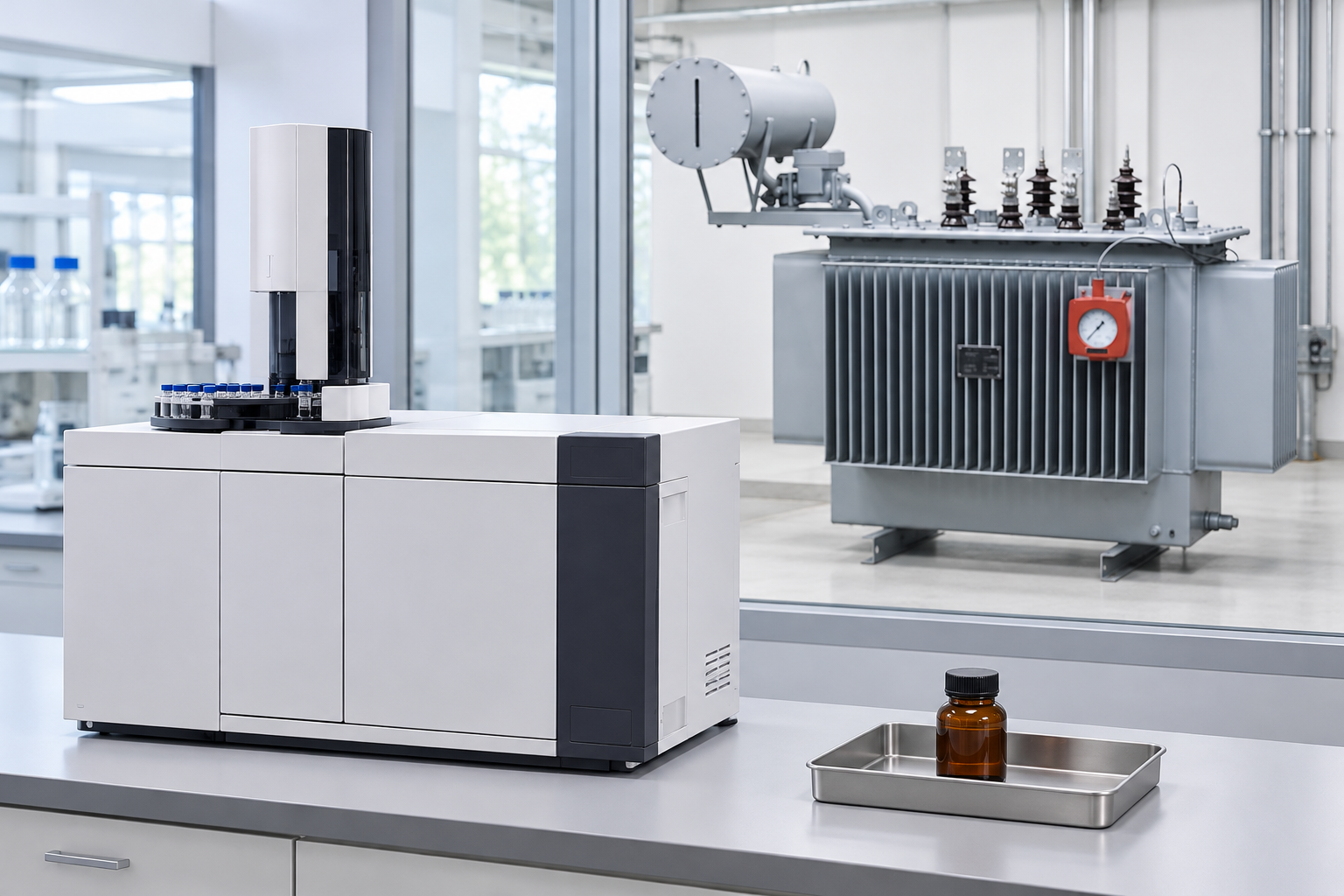
Conceptual illustration of laboratory analysis; no chromatogram, analytical result or validated test configuration is depicted.
Read reporting limits as carefully as measured values
Retain the reported units, method, quantification limit and qualifications. A result below a reporting limit is not automatically an exact zero. If the laboratory changes its reporting capability between samples, a newly reported low concentration may reflect improved measurement rather than a new equipment event. Ask the analyst to explain that distinction.
When comparing reports from different laboratories, obtain a technical assessment of comparability before drawing a trend. Similar units do not guarantee identical sampling, calibration or reporting practice. Keep the original certificates available so that reviewers can see qualifiers that may disappear when results are copied into a spreadsheet.
Gas chromatography is one analytical approach discussed in CIGRE’s public brochure description. The method still needs appropriate validation for the specimen and purpose. An instrument name is not enough to demonstrate analytical suitability, and a generic chromatography demonstration does not establish the laboratory’s uncertainty or detection capability for transformer oil.
Record the context that can change a concentration
A measured marker concentration reflects the specimen collected at a particular time. Record oil and operating temperatures where available, loading context, compartment, collection point and relevant maintenance. Do not create values that were never recorded. Mark missing context explicitly so a later reviewer can judge how strongly two samples can be compared.
SINTEF’s publication on transformer paper-ageing markers describes the influence of fluid system and temperature-related behaviour on oil-measured indicators. Its findings are a reason to preserve context, not permission to apply an arbitrary correction factor from another insulation system. Any correction used for a decision needs a justified method and defined applicability.
Document oil replacement, topping up and processing dates. A concentration change following intervention should not automatically be described as paper recovery or accelerated degradation. The liquid inventory and marker distribution may have changed. Ask the specialist how the intervention affects the baseline and what subsequent observations are needed.
A practical review table for methanol reports
Kawasan semakan
Bukti untuk disimpan
Soalan untuk diselesaikan
Specimen identity
Asset, compartment, collection point and date
Does this specimen represent the intended oil system?
Analytical capability
Method, unit, reporting limit and qualifications
Can the reported values be compared meaningfully?
Operating context
Available temperature, loading and recent events
Could different sampling conditions affect interpretation?
Liquid history
Fluid type and replacement, mixing or treatment records
Does the previous baseline remain relevant?
Other evidence
Complementary markers, diagnostic findings and engineering review
What conclusion is supported beyond the measured concentration?
This table contains no universal alarm concentrations. The objective is to organise an evidence package. If a laboratory or service provider proposes a threshold, ask for its source, applicable fleet or model, and limitations. Keep the difference between a screening trigger and an asset replacement decision explicit.
Combine markers without treating them as interchangeable
Furan analysis addresses another group of oil-measured compounds used in paper-insulation assessment. Methanol and furans should retain separate analytical identities and interpretation notes. Agreement can strengthen an investigation, while disagreement should prompt review of context and limitations rather than selective reporting.
Dissolved gas analysis supplies different evidence about gases in the collected oil. It does not turn a methanol concentration into a direct paper-strength measurement. Keep each test attached to its purpose, then ask what the combined observations support about the actual equipment.
The CIGRE reference paper on solid insulation at end of life discusses the wider difficulty of assessing ageing from indirect evidence. That perspective helps prevent a single chemical result from becoming a complete life assessment. Localised degradation and the overall insulation condition are questions requiring more than one measurement.
Build a usable trend rather than a collection of numbers
Use consistent specimen identification and keep reports in time order with intervention records. Where feasible, retain a consistent analytical approach. Flag a method change or laboratory change in the trend record instead of hiding it. A visible break in comparability is more honest and more useful than an apparently smooth chart assembled from incompatible measurements.
If a result is surprising, first check identity, units, transcription and laboratory qualifications. Then review whether the specimen and operating context are comparable with the previous sample. Resampling can be useful when there is a defined uncertainty to resolve; it should not be repeated until a preferred result appears.
A marker trend needs the original reports and equipment history; blank folders here represent records, not actual analytical findings.
The panduan persampelan minyak supports representative collection planning. Follow the laboratory’s specific instructions for methanol analysis and maintain the collection record. Sampling near electrical equipment remains work for authorised personnel under the owner’s safety procedures.
The oil transformer buying guide provides the wider procurement framework for maintaining an equipment record. For new equipment, agree which initial fluid certificates and asset documents will become the monitoring baseline. A future condition assessment is easier when the original oil identity and relevant factory records remain connected to the installed unit.
Agree the decision and the next observation
Conclude the review with a written statement of what is known, what remains uncertain and what action follows. That may involve confirming analytical comparability, collecting missing history, arranging specialist review or setting a justified follow-up plan. Avoid claiming that the test alone approves continued operation or establishes a replacement date.
Record who owns the next action and which additional finding would change the assessment. This is more practical than requesting an undefined package of further tests. If the equipment supplier is consulted, provide the actual reports and context rather than an isolated concentration copied into an email.
For a new monitoring programme, decide in advance how original certificates, sample identifiers and intervention notes will be stored together. If an analytical result is later corrected, preserve the original and the laboratory’s revision notice. A correction should remain distinguishable from a new measurement. This prevents an administrative change from appearing as a sudden improvement or deterioration in the insulation trend.
Learn the analytical background
The following NPTEL lecture explains gas chromatography and mass spectrometry as analytical techniques, including identification, calibration and interpretation. It supports understanding of the laboratory-method discussion. It does not demonstrate a validated transformer-oil methanol method or provide paper-ageing thresholds.
Does methanol analysis directly measure paper strength?
No. It measures a marker in oil. Paper condition requires interpretation with equipment history, other observations and the limitations of the analytical evidence.
Is there one normal methanol level for every transformer?
No universal concentration should be assumed. Design, cellulose-to-oil ratio, loading and other contextual differences affect interpretation and fleet comparisons.
Does a lower result after oil replacement prove paper recovery?
No. Oil intervention changes the context of the measured concentration. It does not demonstrate that degraded cellulose has regained its original strength.
What makes a methanol trend useful?
Traceable specimens, comparable methods and units, retained reporting limits, relevant operating context and documented oil interventions make changes easier to evaluate.
Shenheng Electric Power komited untuk menjadi peneraju global dalam penyelesaian peralatan kuasa, membantu pelanggan mencapai pengurusan kuasa yang selamat, cekap dan mampan.

 Shenheng Power Equipment Co., Ltd.