
 Shenheng Power Equipment Co., Ltd.



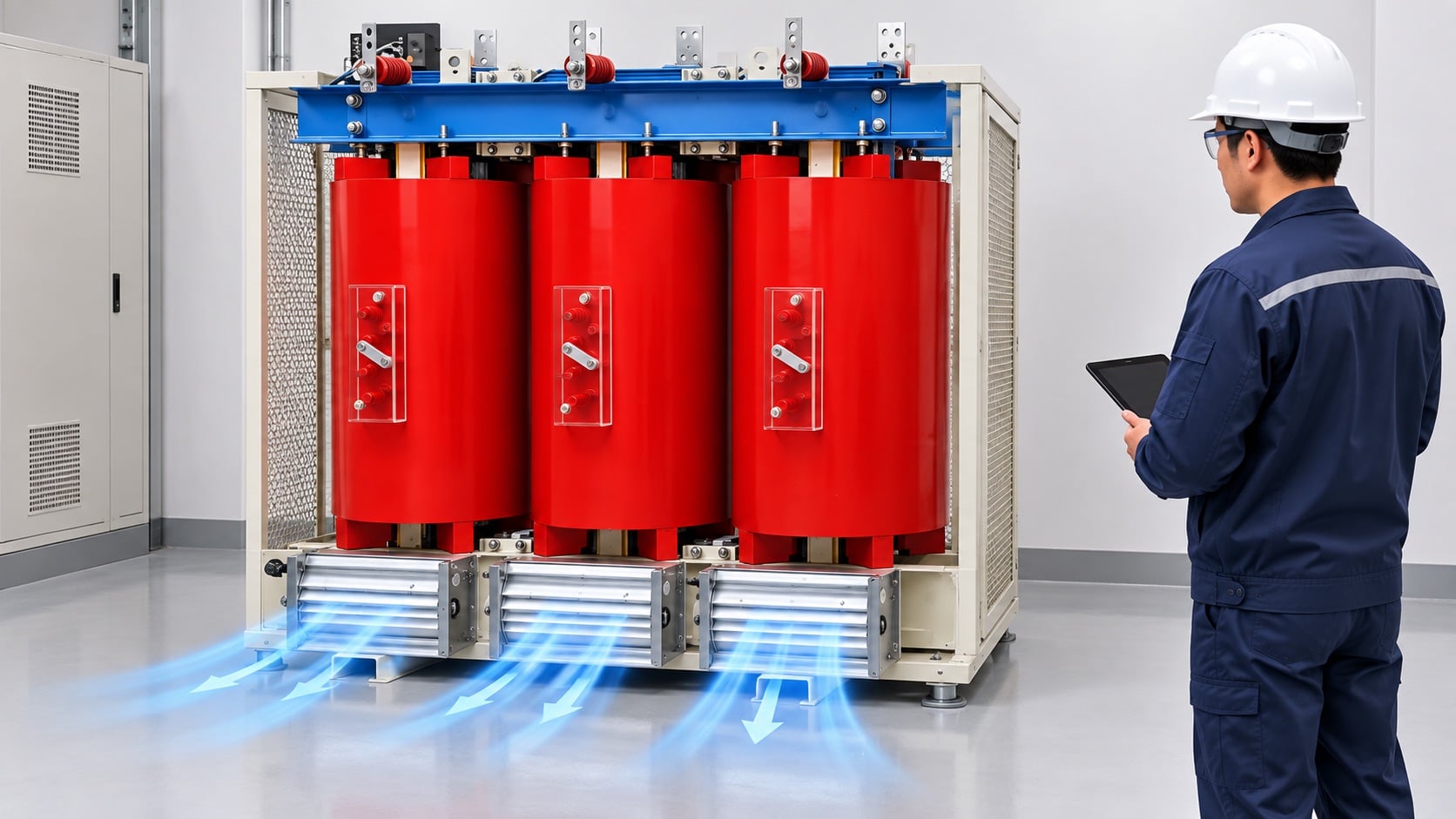
dry type transformer fan control is a focused engineering question that needs a defined boundary before a calculation, inspection or commissioning decision is made. Dry type transformer fan control manages forced-air cooling when the transformer temperature or load reaches the manufacturer’s defined operating point. Fans can increase available capacity or control winding temperature, but they do not make any dry type transformer universally suitable for overload. The control system must coordinate sensors, fan starters, protection, alarms, manual test mode and loss-of-fan response. Correct ventilation and clearances remain necessary even when fans are installed. Use the actual transformer manual and approved control drawing for setpoints and wiring.
Natural cooling and forced air
A dry type transformer may operate with natural air circulation under normal load and use fans during higher loading. The cooling designation, sensor location, fan capacity and enclosure arrangement are part of the verified design. A fan blowing across a blocked outlet cannot deliver the expected heat removal. Before discussing control, confirm the room, louver, filter and cable-entry arrangement.
IEC 60076-11 covers dry-type power transformer requirements, and IEC 60076-12 addresses loading guidance for dry-type transformers. These standards define families of requirements, not a universal fan setpoint. The supplier should identify the cooling mode and provide the control logic for the offered transformer.
Sensors and control points
Temperature sensors may be embedded in windings, attached to a core area or located at another manufacturer-defined point. The controller may use the highest phase, a calculated value, or a staged threshold. Do not move a sensor or replace it with a different resistance curve without approval. Verify sensor type, terminal numbering, polarity where applicable and alarm contacts during commissioning.
The control panel should distinguish normal fan operation, fan failure, high temperature, sensor fault and transformer trip. A single green lamp does not provide enough information for a critical installation. Record the sensor calibration or acceptance check and keep the controller manual with the transformer records.
Automatic, manual and test modes
Automatic mode should follow the approved temperature or load logic. Manual mode can be useful for maintenance, but it must be protected against being left active or bypassing a trip. A spring-return test switch, key control or supervised software command may be required by the project. Clearly label the control states on the drawing and local panel.
Fan operation at no load can create noise and unnecessary wear. Delayed start or stop may be used to avoid rapid cycling, but the time must come from the design. Do not invent a delay because it sounds reasonable. Confirm the controller response at low temperature, threshold crossing, sensor failure and loss of auxiliary power.
Fan selection and airflow
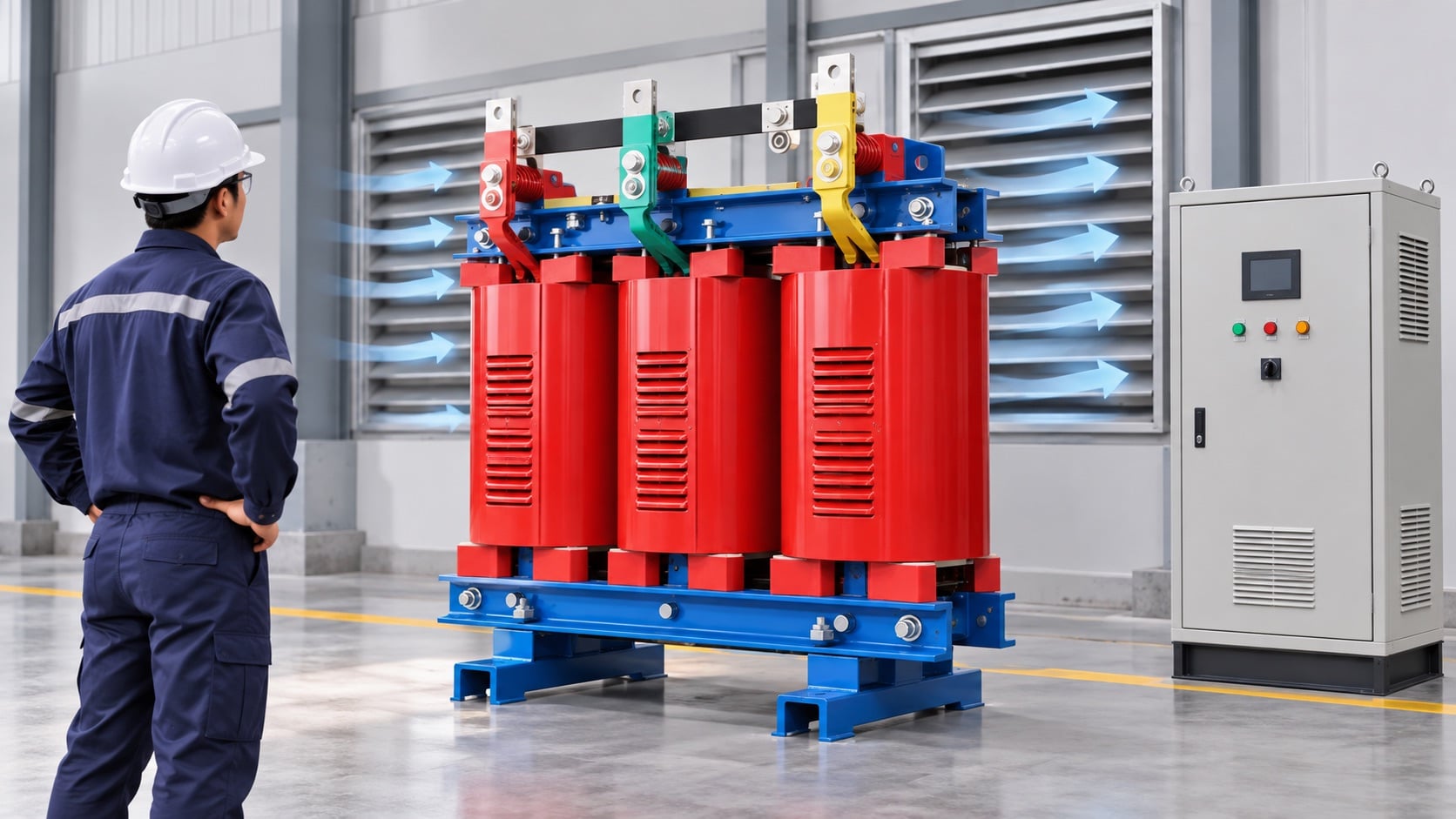
Fans must be matched to the transformer enclosure, pressure drop, acoustic requirements, dust level and ambient. Airflow should move through the intended heat path rather than recirculate inside a cabinet. Filters and louvers need access for inspection. Cable trays, fire barriers and walls can change the original airflow and should be included in the installation review.
The product page linked here shows a cast-resin transformer category. It is not evidence of a specific fan rating or control setpoint. Ask the supplier for the fan model, power supply, protection device, airflow basis and maximum permitted ambient. Confirm that the forced-air rating applies to the complete installed arrangement.
Protection and interlocks
Each fan motor needs the specified short-circuit and overload protection, isolation and earthing. The transformer should not silently remain in a high-load operating state when all fans have failed. The control scheme may alarm first and trip later depending on the thermal study and owner requirements. Interlock logic must be documented.
Separate transformer protection from fan protection in the schematic. A fan breaker trip should not automatically trip the transformer unless the approved philosophy says so, but it should create a visible alarm and change the available loading state. Verify local and remote indications and alarm priorities in the control room.
Commissioning sequence
Inspect fan guards, rotation, bearings, mounting, vibration, filters and clearances before applying auxiliary power. Prove the sensor inputs, controller thresholds using a safe simulation, fan start/stop, alarm contacts and trip logic. Confirm phase sequence and motor current where applicable. Do not put hands near rotating equipment.
After functional testing, run the transformer at a representative load and record temperatures, fan status, ambient and airflow observations. Check for hot spots, unusual noise or recirculation. A thermal survey of accessible surfaces can support trending but cannot replace internal design evidence. Store the final setpoints and test result with the asset ID.
Maintenance and failure modes
Common issues include blocked filters, failed contactors, loose sensor terminals, incorrect sensor type, seized bearings, noisy fans and a controller left in manual mode. A fan can run while airflow is inadequate if the impeller, filter or direction is wrong. Maintenance should inspect the whole heat path, not only the run lamp.
Trend temperature and fan runtime together. A rising temperature at unchanged load may indicate airflow degradation or sensor drift. If a fan is unavailable, follow the manufacturer emergency-loading limits and reduce load as required. Do not improvise a portable fan inside an energized enclosure.
RFQ and handover checklist
Ask for cooling designation, sensor type and location, control schematic, fan schedule, setpoints, alarm and trip matrix, auxiliary voltage, motor protection, enclosure airflow, noise limits, spare parts and maintenance intervals. Require a test procedure covering normal, alarm, failure and restoration states.
At handover, retain as-built wiring, controller configuration, fan rotation check, sensor records, protection settings and thermal baseline. Link the temperature monitoring guide for trending and the clearance guide for airflow and installation conditions.
| Verificar | Evidência a registar | Porque é que isso importa |
|---|---|---|
| Definição | Formula, boundary and operating state | Prevents two teams comparing different quantities. |
| Equipment | Rated voltage, current, construction and approved drawing | Links the calculation or checklist to the actual product. |
| Conditions | Ambient, temperature, power factor or pollution as applicable | Explains why field behavior can differ from a catalog value. |
| Verificação | Test method, instrument, result and acceptance basis | Creates an auditable commissioning record. |
| Controle do processo de mudança | Deviation, owner approval and as-built revision | Stops an unreviewed site change becoming a hidden risk. |
Guia de produtos e engenharia relacionados
Para o contexto de produto correspondente do Shenheng, consulte a página de produto relevante. Para o assunto mais amplo, leia O guia de engenharia dos pais. Leia também: primeiro guia relacionado e segundo guia relacionado.
Fontes e normas
Fonte da autoridade 1 · Fontes da autoridade 2
Como usar o resultado em um projeto
Start with the final equipment identity and the released design. Note the operating state, measurement point, environmental conditions and the decision the result must support. Then compare the evidence with the applicable standard, manufacturer instruction and project acceptance plan. If any prerequisite is missing, keep the item open rather than filling the gap with a generic value. This approach helps a buyer, commissioning engineer and operations team discuss the same physical asset.
For a supplier inquiry, ask for the calculation basis, verified arrangement, limits, test records and deviations. For site work, record the person, instrument, date, isolation boundary and restoration check. A concise but complete record is more useful than a long report that hides the one fact needed to approve the next step.
Safety and change control
Electrical equipment can retain energy or become energized from more than one source. Work that exposes conductors, removes barriers or changes a protection or control function requires an approved permit, isolation, absence-of-voltage verification and qualified supervision. Do not use this article as a switching instruction. If the installed arrangement differs from the drawing, stop and obtain engineering disposition before continuing.
After a test or inspection, restore covers, bonds, shutters, interlocks, labels and settings. Use an independent check for critical restoration steps. Record exceptions and link them to the final asset record. This protects future maintenance teams from relying on a temporary test state.
When evidence is incomplete, identify the missing input and assign a review owner. Do not backfill a rating, setpoint, clearance or test result from a different product family. Keep the product family, voltage class and site environment consistent from the first calculation to final handover. This makes later trend comparisons meaningful and gives procurement a clear list of questions for the supplier.
Vídeo para contexto do sistema
This neutral Practical Engineering explainer gives useful context for substations, transformers and switchgear. It is background education, not a project test instruction.

Perguntas frequentes
What is the main mistake to avoid?
Treating one percentage, dimension or indicator as a universal acceptance value. The dry type transformer fan control decision must use the applicable standard, actual equipment and documented conditions.
Can the product page replace project engineering?
No. The linked product page identifies a relevant Shenheng product category. Ratings, accessories, settings and acceptance values must come from the project documents and supplied equipment.
What should be kept for handover?
Retain the approved drawing, raw readings, test method, instrument information, deviations, final settings and the as-built record so the result can be reproduced.
Does this guide authorize live work?
Não. O pessoal qualificado deve seguir o programa de segurança elétrica do local, as instruções de isolamento e as instruções do fabricante.




