Seit 2001 ist Shenheng Power ein vertrauenswürdiger Hersteller von Energieübertragungs- und -verteilungsausrüstung und liefert weltweit zuverlässige elektrotechnische Lösungen.
Unterstützt durch ein umfassendes Kundendienstsystem bieten wir kompetente technische Beratung, Produkthinweise sowie flexible OEM- und ODM-Dienstleistungen für Ihre Projekte.
Seit 2001 ist Shenheng Power ein vertrauenswürdiger Hersteller von Energieübertragungs- und -verteilungsausrüstung und liefert weltweit zuverlässige elektrotechnische Lösungen.
Transformer Oil Color Test: What a Darker Sample Does and Does Not Mean
Veröffentlichungstermin: 2026-10-23
A transformer oil color test describes the appearance of an insulating-oil specimen using a defined comparison method. A darker result can prompt investigation, but it does not independently prove oxidation, contamination, overheating or the need to replace the oil. Confirm the fluid identity, compare results produced by the same method, and assess any change together with clarity, sampling history and laboratory condition tests. A phone photograph or a description such as dark brown is an observation, not an ASTM color result. The most useful question is what changed, whether that change is repeatable, and which further evidence can explain it.
Color and condition are related but different
Color is readily visible, which makes it attractive as a quick maintenance indicator. It is also easy to overinterpret. Two liquids can look similar while differing in water content, electrical properties or fault-related gases. Conversely, a visible difference may partly reflect lighting, container geometry or a different fluid formulation rather than a newly developed equipment problem.
ASTM D1500 provides a visual petroleum-product color method and identifies the result as ASTM Color. Its published explanation cautions that color alone is not always a dependable quality indicator. Use the measurement to support a defined comparison, rather than turning a familiar shade into a universal pass-or-fail rule.
An owner assessing an Ölgekühlter Industrietransformator should retain the actual oil certificate and initial test results. Neither the exterior paint color nor the transformer voltage establishes the color of the original fill. Procurement documents should identify the liquid supplied and the applicable acceptance specification.
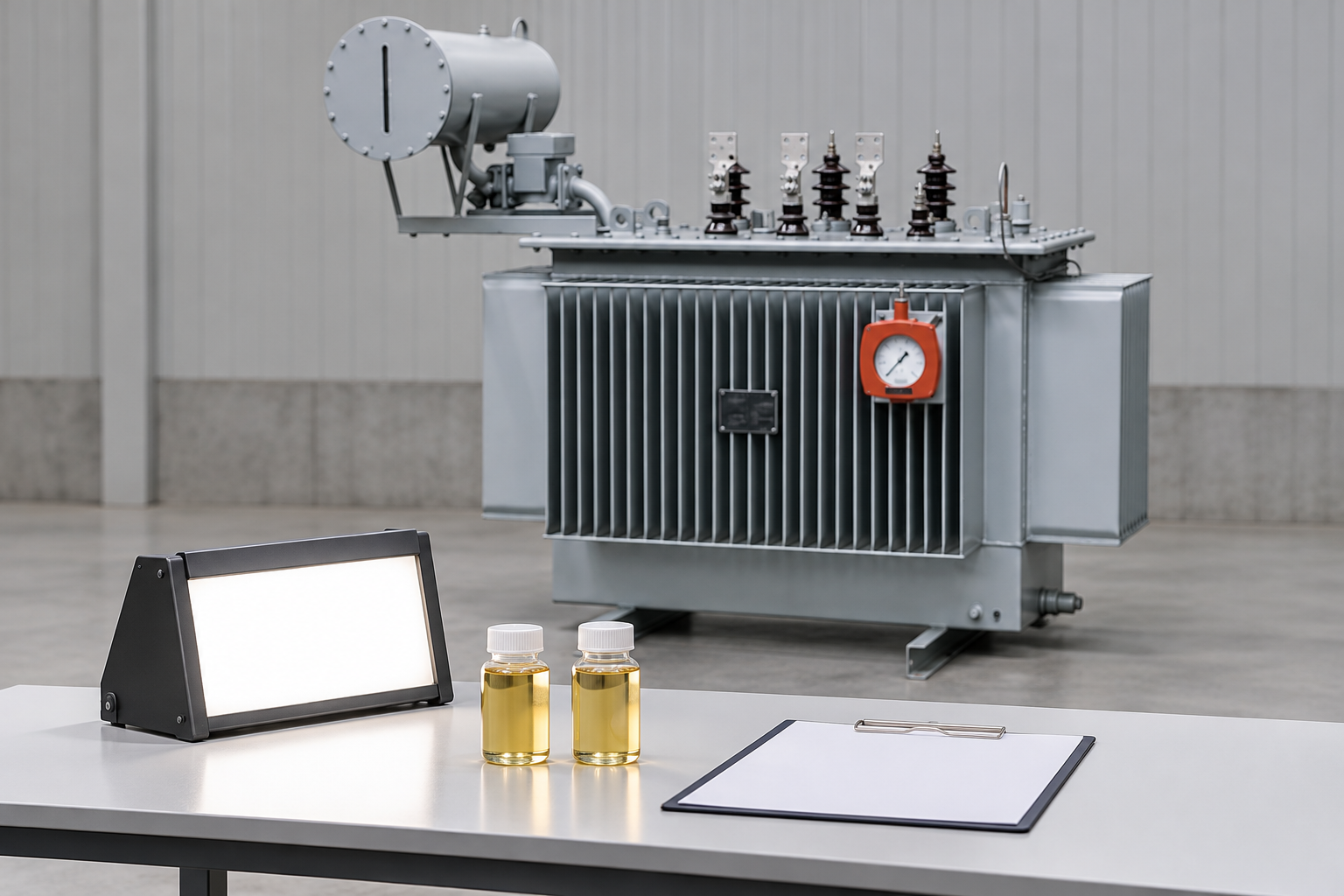
Use controlled observation conditions; this illustration is not an ASTM color scale. Reference-based illustration.
What an ASTM color report means
A valid report identifies the sample, method and result. The number belongs to that method’s comparison system; it is not a concentration of oxidation products. Do not assume that doubling a reported color value means the oil has deteriorated twice as much. Similarly, a change in the last reported digit should not be treated as a precise change in remaining life.
Ask the laboratory how a specimen outside the useful comparison range is reported and whether the selected method suits a very pale or otherwise unusual liquid. Keep any reporting qualifier attached to the result. Do not strip a less-than sign, dilution note or observation from a spreadsheet merely to make a graph easier to draw.
Other color scales or instrumental measurements may be appropriate for particular purposes, but their outputs should not be silently relabeled as ASTM Color. Before combining historic results, check the method, sample preparation and reporting convention. A trend is meaningful only when its points have a sufficiently consistent measurement basis.
Separate color from clarity and visible contamination
ASTM D1524 concerns field visual examination of used electrical insulating liquids. Its published description distinguishes unusual color changes from observations such as cloudiness and suspended material. These observations help decide whether a specimen needs fuller laboratory evaluation. They do not identify every contaminant by appearance alone.
For example, a clear amber specimen and a cloudy amber specimen may have similar apparent color but present different questions. Record both observations instead of compressing them into a single word such as bad. Cloudiness can justify investigating moisture or other causes, while visible particles need appropriate identification. Their exact origin cannot safely be assigned from a photograph.
If a sample appears to contain sediment, do not casually filter it before sending it to the laboratory. That could remove evidence relevant to the investigation. Ask the laboratory how it wants the sample handled and transported. Record the initial appearance and any handling changes so the final report can be interpreted against what was actually received.
The following table is a review guide, not a set of acceptance thresholds. The observation categories follow the distinction between color measurement and visual examination; the follow-up depends on the asset and the owner’s approved maintenance process.
Observation
First verification
Useful next question
Conclusion to avoid
Darker than the previous sample
Same fluid, method and comparable observation conditions
Did treatment, top-up or service conditions change?
Darker always means immediate replacement
Similar color but cloudy
Confirm a representative sample and record clarity separately
Which laboratory tests can investigate the cloudiness?
Similar color proves unchanged condition
Visible particles or sediment
Preserve and document the specimen as received
Does the laboratory need a separate particle investigation?
Particle origin can be identified by shade alone
New oil differs from the certificate
Check batch identity and the actual test designation
Does a controlled confirmation meet the purchase requirement?
A phone image settles contractual acceptance
Abrupt color change after oil work
Check replacement, reclamation and mixing records
Is a new baseline required?
The old trend remains directly comparable
How to make observations repeatable
Follow the site’s sampling procedure and the laboratory’s container instructions. Record the transformer identity, compartment, sampling point, date and relevant operating or maintenance context. Use the approved equipment and access controls; a general article is not authorization to approach energized components or operate a sampling valve.
For visual records, retain consistent lighting, background, container type and viewing arrangement where practical. A pale liquid viewed through a deep bottle can appear darker than the same liquid through a narrow path. Dirty glass, tinted containers and strong reflections can also change the impression. These are reasons to control the observation, not reasons to ignore a confirmed change.
Photographs can document appearance and support communication, but automatic white balance and exposure can shift the apparent color. Avoid using a photographed reference card as a substitute for a laboratory measurement. Keep original image files and note the observation conditions, especially if the photograph forms part of a maintenance investigation.
Why darkening needs a broader investigation
Oxidation-related changes are one possible context for darkening, but the owner should investigate rather than declare a cause. Consider oil identity, time in service, recent additions, treatment history and other laboratory results. A conclusion becomes stronger when independent evidence points in the same direction and the sample history is reliable.
Acidity and interfacial tension can provide complementary information about the liquid. Water and dielectric breakdown tests address different aspects of condition. The oil acidity guide und oil moisture guide explain those separate questions. The laboratory should help select a package that can discriminate between the plausible explanations.
If the concern is an active internal fault, use the Anleitung zur Analyse von gelöstem Gas alongside operating evidence and the owner’s response process. Neither a light color nor a dark one can rule that question in or out. Do not wait for a color result to respond to independent alarms or abnormal equipment behavior.
Keep lighting, specimen identity and supporting records consistent. Reference-based illustration.
What light absorption adds to understanding color
A liquid’s visible appearance involves its interaction with light. Laboratory optical methods control the measurement more carefully than an ordinary photograph, but the chosen output still needs a defined interpretation. An absorbance reading, a research color index and a visual ASTM Color result are not automatically interchangeable quantities.
The following NPTEL lecture from IIT Roorkee introduces UV-visible spectroscopy, helping explain why wavelength, optical path and measurement conditions matter when light passes through a specimen. It provides background for understanding optical measurements. It is not an ASTM D1500 demonstration, a transformer acceptance method or evidence that an experimental optical index can replace the specified test.
This boundary is useful when evaluating a proposed portable instrument. Ask what quantity it reports, which calibration and method support it, how sample condition affects the result and whether the purchase or maintenance specification accepts that method. Convenience alone does not establish equivalence to a required laboratory result.
Investigate a sudden change before choosing treatment
Consider a hypothetical report that changes sharply after an outage. Before attributing the change to accelerated aging, reconcile the outage records. Was oil added? Was the sample taken from the same compartment and point? Did the laboratory change the method? Was the bottle or transport history unusual? These checks can reveal a comparison problem without dismissing a genuine condition change.
If the change is confirmed, ask the responsible engineer and laboratory to assess the supporting tests and operating history. The outcome might be closer monitoring, additional investigation or an approved corrective action. Avoid selecting treatment solely because it makes the liquid look clearer; visual improvement does not demonstrate restoration of every electrical or chemical property.
Oil replacement, reclamation or filtration can alter the baseline and may also affect subsequent diagnostic interpretation. Preserve the original reports, treatment records and post-work results. Define what success means before work starts, including the measurements needed to verify the intended improvement. A before-and-after photograph is useful documentation but insufficient acceptance evidence.
Include color requirements in procurement and handover
For a new transformer, specify the fluid and required documentation within the oil-immersed transformer buying process. Agree which test designation and acceptance criteria apply to the delivered oil. A vague requirement for clean-looking oil creates unnecessary uncertainty when the equipment reaches site.
Retain batch certificates, delivery records and the initial sample report in the handover file. If the oil product changes during manufacture or filling, document the substitution and its approval. The future maintenance team needs a baseline for the actual liquid, not a certificate copied from an earlier proposal.
When reviewing an existing installation, request the information that connects observation to decision: reliable identity, comparable measurement, change history and supporting condition results. That approach helps avoid both premature replacement and false reassurance. It also leaves an auditable explanation for the next engineer who reviews the transformer.
Häufig gestellte Fragen
Does dark transformer oil always need replacement?
No. A confirmed change needs investigation, but color alone does not establish the required treatment. Review the fluid identity, trend, other condition tests and operating evidence before making a replacement decision.
Can a phone photograph provide an ASTM color number?
No. Ordinary photographs do not provide the controlled comparison required by the named test. Lighting, exposure, white balance and container geometry can alter appearance. Use photographs as supporting records and obtain a defined laboratory result when required.
Is clear oil necessarily dry and electrically sound?
No. Visual clarity does not measure all moisture or electrical properties. Use the appropriate tests for those questions, and do not let a reassuring appearance override independent evidence of deterioration or a fault.
Can results from different color methods be put on one trend?
Only with a justified comparison. Keep method names, qualifiers and sample preparation details. Ask the laboratory whether the results are comparable before joining them into a single history or interpreting the difference as deterioration.
Shenheng Electric Power hat sich zum Ziel gesetzt, ein weltweiter Marktführer für Lösungen im Bereich Energieausrüstung zu werden und Kunden dabei zu helfen, ein sicheres, effizientes und nachhaltiges Energiemanagement zu erreichen.

 Shenheng Power Equipment Co., Ltd.